On this pageJump to a section
I do not have a philosophy about broad targeting.
That probably sounds strange from someone who has bought Facebook and Instagram traffic since 2014. Online, the topic has become a religion. One camp says detailed targeting is dead and you should trust the machine. The other says automation will eat your budget and you should keep your hands on the wheel. Both camps have screenshots.
What I have is a checklist. Whether Advantage+ audience helps you or burns you depends on two things that have nothing to do with belief: the signal quality you send back, and the conversion volume you can feed it.
What is Advantage+ audience, and what does it actually change?
It changes who decides, not whether targeting exists.
Meta's page says Advantage+ audience takes your usual audience selections, such as a customer list, a gender or an interest, and expands beyond them, looking outside your set parameters to find the people most interested in your products.1 You can add audience suggestions, including custom audiences, lookalikes, age, gender and detailed targeting. The system prioritizes people who match the suggestion before searching more widely.1
What you still control
You can set strict criteria the system should not expand beyond: minimum age, location, language and custom audience exclusions.1 Meta's page also says that for new campaigns it is applied automatically where available, and you can switch back to original audience options.1 That default is why so many accounts changed behavior in 2024 without their owners making a decision.
What decides whether broad delivery works?
Two inputs. Everything else is commentary.
- Conversion signalAccurate events, ideally purchases or qualified leads
- Event volumeAbout 50 results per ad set per week
- Clear creativeThe ad does the selecting
- Advantage+ audienceExpands from your suggestions
- JudgmentCost per paying customer, not per click
Signal quality
Automated delivery optimizes toward the event you tell it to chase. If that event is a form fill from anyone, it will find more form fillers. If that event is a qualified lead or a purchase, it has a chance to find buyers. The cleaner and more complete your conversion data, the better the system aims. Meta describes the Conversions API as a way to connect your own marketing data to its systems for optimization and measurement.3 I covered how to set it up and deduplicate events not long ago.
Conversion volume
The machine needs examples. Meta's help center says ad sets usually exit the learning phase after about 50 results in the week after the last significant edit, and that during learning performance is less stable and the cost per result is usually higher.2 If your budget cannot produce about 50 of your chosen event per week, the system stays in a state of guessing, and a broad audience gives it a very large place to guess.
When should you let Meta drive?
When the inputs are good and the stakes of wasted spend are tolerable.
| Let Meta drive when | Keep tighter control when |
|---|---|
| You can reach about 50 real results per ad set per week | Your event volume is far below that |
| Conversion data includes purchases or qualified leads | Your only event is a cheap form fill |
| Your creative is clear about who it is for | Your creative is generic and the audience does the filtering |
| Your offer sells to a wide group | Your offer sells to a narrow, specific buyer |
| You can accept a noisy learning period | You cannot afford a bad week |
Creative becomes the audience
With broad delivery, your ad does the selection. The person it speaks to stops to watch, and the system learns to show it to more people like them. Vague creative produces vague audiences. That is why a broad account with weak creative is a recipe for expensive impressions.
Jon Loomer drew the same line in a video posted on February 26, 2024: "If you're optimizing for a purchase use Advantage Plus audience with confidence."5 He also says that for top-of-funnel goals such as link clicks, the original audience options can make more sense, which matches the control cases below.
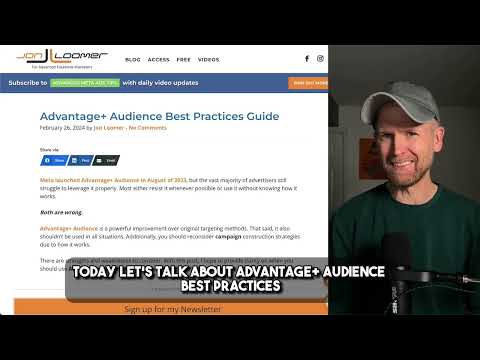
VideoJon Loomer
Advantage+ Audience Best Practices
Loomer's seven-minute walk-through covers audience suggestions and why overlapping ad sets can raise costs.
When should you keep tighter control?
There are real cases, and they are not about stubbornness.
- Legal or policy constraints. If you operate in a regulated area, you may need to limit who sees an ad and what you say. Use hard controls for what the platform allows you to constrain.
- Geography. If you can only serve certain places, set the location as a hard limit. A suggestion is not a boundary.
- Tiny budgets. With very little volume, structure matters more. Fewer ad sets, a deeper but reachable optimization event and no daily tinkering.
- Narrow buyers. If your offer is for a specific professional or situation, broad delivery may spend a lot learning that most people are wrong for it.
Keep the structure simple either way
Meta's guidance for the learning phase is to avoid unnecessary edits, avoid high ad volumes, combine similar ad sets and use realistic budgets, since frequent budget changes can send an ad set back into learning.2 More ad sets means each one learns less. Consolidation is usually the right move on a small budget.
How do you test it without wrecking your account?
Change one thing, hold everything else still, and give the test time to learn.
- Pick the question. For example: does broad delivery beat my current detailed targeting on cost per paying customer?
- Match the conditions. Same creative, same optimization event, same offer and comparable budgets.
- Set hard controls first. Lock location, age floor, language and exclusions so the comparison is fair.
- Let both exit learning. Do not judge until each has had a fair run, around the 50-result mark.
- Judge by paying customers. Compare cost per sale or qualified booking, not cost per click or lead.
- Keep the winner, retest later. Auctions and creative change. A result is a snapshot.
What mistakes burn accounts?
- Switching everything at once. You cannot tell what worked.
- Judging on day two. The learning phase is noisy by design.
- Optimizing for the cheapest event. It is easy to hit and says little about who buys.
- Editing winners. A significant edit can reset learning.
- Ignoring the auction. Meta's Q2 results showed ad impressions up 10% and average price per ad up 10%, so wasted learning gets pricier, not cheaper (I broke down those numbers in my mid-2024 read).4
Broad targeting is not magic and detailed targeting is not dead. Both are only as good as the data behind them.
If your account is stuck between the two camps, the fastest way out is to audit your signal and your volume first. If you want someone to pressure-test your audience setup, start here.
Keep building.Ekai
Questions people ask
What is Advantage+ audience?
Advantage+ audience takes your usual audience choices, such as a customer list, gender or interest, as suggestions and expands beyond them to find people more likely to convert. You can set hard limits such as minimum age, location, language and custom audience exclusions.
Is Advantage+ audience better than detailed targeting?
Neither is better in general. Broad, automated delivery tends to work when you have enough conversion volume and accurate conversion data. When either is thin, tighter control can protect your budget.
How many conversions do I need to exit the learning phase?
Meta's help center says ad sets usually exit the learning phase after about 50 results in the week after the last significant edit.
Can I still control who sees my ads with Advantage+ audience?
Yes, through audience controls. Meta lets you set strict criteria the system should not expand beyond, including minimum age, location, language and custom audience exclusions.
Sources
- 1
- 2
- 3
- 4
- 5
